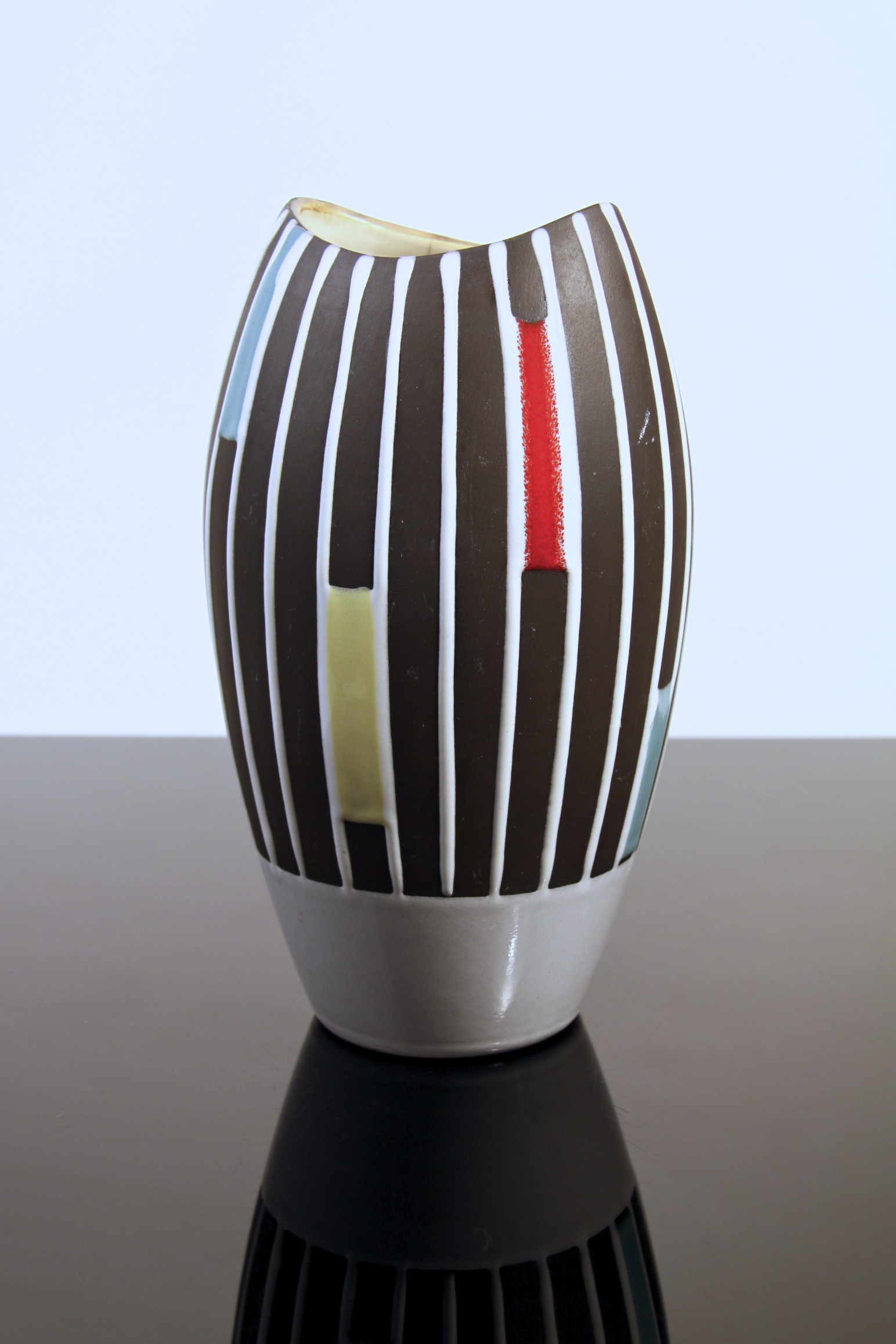
vintage

Cenedese, Murano Sommerso organic glass vase in red and yellow, designed by Antonio Da Ros, Venice, Italy circa 1960’s

This Cenedese single stem vase, encapsulates everything great about Murano art glass.  The beautiful organic shape with its contrasting sharp angled rim marks a clear break from tradition, embracing the space age futuristic styles of the 1960s.  The handmade blown glass is skillfully and amazingly layered using the Sommerso (submerged) technique, creating encased coloured capsules that need no other adornment.  It catches and refracts the light beautifully and becomes a sculptural piece of art in its own right.
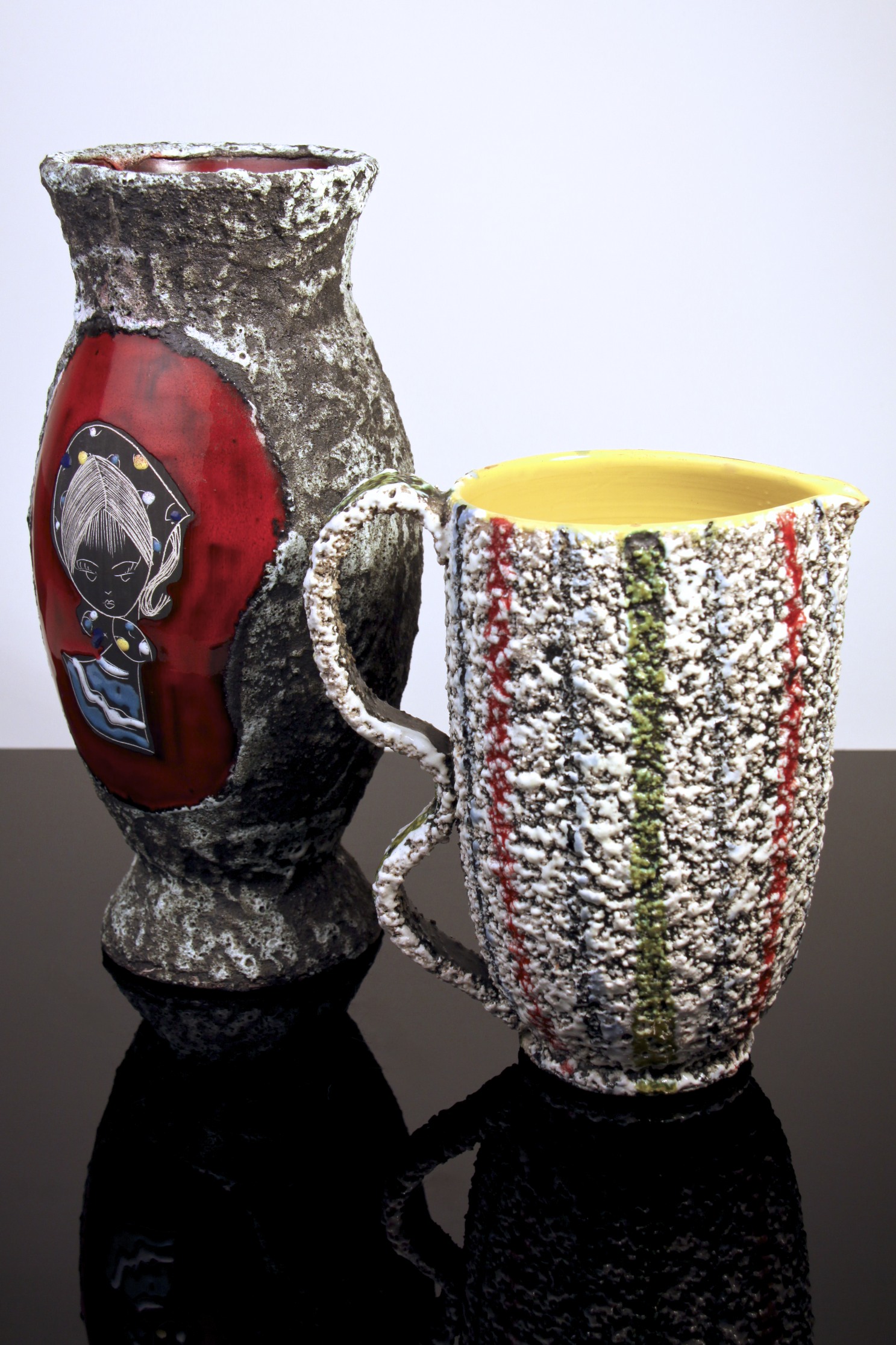
San Marino rock glaze and sgraffito vase and Fratelli Fanciullacci textured striped jug, Italy circa 1960’s

These two pieces illustrate how Italian potteries were leading the way with innovative mid-century modern ceramic design.  From the San Marino’s trademark foamy white smalto roccia (rock glaze) that predated West German ‘Fat Lava’ styles, combined here with a highly stylised fashionable sgraffito image, evoking the 1960’s Italian glamour sought out by the new influx of foreign tourists.  The Fratelli Fanciullacci jug with its heavily textured glaze and hand painted stripes is inspired by the resurgence in studio pottery in Italy at the time, and was important in the revival of craft and the growth of ‘Made in Italy’ after the war.

Exbor / Novy Bor Glassworks , Sklo Union, pink, colourless and green cased faceted vase, designed by Pavel Hlava, Czechoslovakia circa 1958.

A striking example of the renaissance in Czech glass design in the 1950’s.  From behind the Iron Curtain, re-establishing the country’s skilled designers reputation for producing unique art glass masterpieces. Pavel Hlava designed this range for exhibition at the Milan Triennale in 1957, the first time in over 20 years Czech glass was seen internationally, whilst showcasing their modern products for a modern age and people.  With its monumental form and coloured internal design it is as much a sculptural piece as a functional vase.

Vintage Goebel Pottery Hedgehog dish, KZ 98, West Germany circa 1950

Whilst the current trend for vintage West German pottery is almost exclusively aimed at the ‘Fat Lava’ genre and the factories that produced outlandish designs, some great designs can be found from unexpected makers.  Such as this lovely Hedgehog dish from Goebel Porzellan, known predominantly for their Hummel figurines!  This is a very stylish Mid-century animal figure that would quite happily sit alongside its ‘Fat Lava’  contemporaries in a collection, and would complement the similarly styled Walter Bosse brass figures.

Vintage ‘dj formula 1’ wooden Skateboard with classic ACS-430 trucks and orange wheels, circa 1970’s

A great collectable wooden skateboard, with its parallel stripes of grip tape, vintage sticker, classic trucks and bright orange wheels.  Still works great, showing signs of wear and tear which only add to its character and history. Perfect for rediscovering your 70’s / 80’s childhood, or for display as a retro accessory!

Charles and Ray Eames ‘House of Cards’, interlocking picture card set, Western Germany circa 1952

The Eames Office  produced 5 different sets of the House of Cards.  The small house of cards is the original, made in 1952.The images are of what Eameses called “good stuff “, chosen to celebrate “familiar and nostalgic objects from the animal, vegetable, and mineral kingdoms.” The six slots on each card enable the player to interlock the cards so as to build structures of myriad shapes and sizes. There was also a Giant House of Cards (1953), a Computer House of Cards (1970) and Newton House of Cards for the 1974 Nobel Laureates for IBM.

Kitsch seascene with Starfish, fish and shells, set in an Atomic era abstract shaped Lucite block paperweight, circa 1950′s

At the moment I’m really loving pieces such as this that exhibit so many characteristics of Mid-century design.  From the use of new types of plastic to create innovative pieces in abstract forms that owes so much to the Atomic-era and the Jet-age, fusing geometric angular shapes with streamlined contours. And the brightly coloured Kitsch underwater scenes, mementos of Inter-Continental foreign travel.